
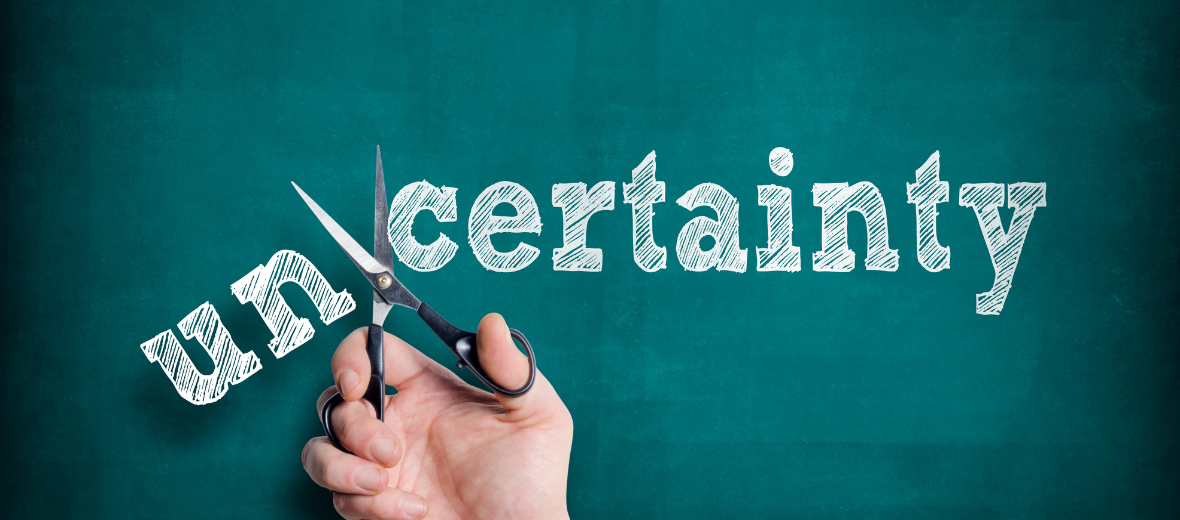
I met with a prospective client last week. He was a really nice guy, very intelligent, and he spent his career building business operations for a large brand across Asia, so he understands risk and uncertainty. Still, sitting across from me, he said the thing almost everyone says or at least thinks.
“I understand investing but don’t want the uncertainty.”
I get it – really I do. Avoiding uncertainty is a basic human response. There’s not many people who enjoy watching a portfolio go down. But I’ve been thinking about that statement since, because it just doesn’t hold up.
What if the uncertainty he wants gone is the very thing he’s being paid for in the long-term?
What you’re actually being paid for
Here’s the logic, and it’s simpler than it sounds. Imagine you knew, for certain, exactly what a share would be worth in a year’s time. No doubts about it, the return is guaranteed.
What would that share be worth today?
Whatever that guaranteed future price is, discounted back a bit for time. That’s it. No premium. No extra return for holding it because there’d be nothing to compensate you for.
No risk.
The only reason anyone earns a real return from holding equities over the long run is that nobody knows what’s coming. That uncertainty – the thing this particular chap wants gone – is the whole mechanism. Remove it, and you remove the reward.
I’ve sometimes quoted a phrase to clients over the years: volatility is your friend.
It sounds odd the first time you hear it. Feels almost backwards.
But think about what volatility actually is. It’s markets doing their job. Prices move because nobody’s certain, because information’s incomplete, because the future isn’t decided yet. That’s normal. That’s healthy, even.
What should actually worry you is the opposite. A market that climbs steadily, month after month, with no bumps and no reaction to anything. Or one that shrugs off something that should matter.
That’s not calm. That’s often a sign something isn’t being priced properly – the uncertainty hasn’t disappeared, it’s just gone quiet for a while. And ignored risk has a habit of turning up later, usually at the worst possible moment.
Volatility showing up is the market being honest with you.
Even I feel the pull
I’ll admit something here, because I am a human and not a robot that operates purely off investment theory!
Even after years of doing this, part of me still wants the smooth version too. Watching a portfolio dip still doesn’t feel good (my reaction is not to check my online accounts), even when you know, intellectually, why it’s happening and why it’s not a problem. However, knowing the theory doesn’t switch off the instinct.
But that’s precisely why this matters. If even someone who spends his working life explaining this to other people still feels the pull toward wanting certainty, that’s just how people are built, not a character flaw in any individual person.
We’re wired to want the ride smoothed out, even when the bumps are what get us anywhere.
So maybe the goal isn’t to eliminate the discomfort at all, but to understand what it’s actually for.
The wobble isn’t a design flaw in investing. It’s the toll you pay for a return that beats sitting safely in cash. Once you see it that way, it doesn’t necessarily feel better in the moment – I’m not going to pretend it does – but it does feel less like something’s gone wrong.
My prospective client last week wanted the uncertainty to go away. I understood exactly why. I’m just not convinced it’s what he really wants, once you follow the idea all the way through. Take away the not-knowing, and you take away the reason it all works.
Still think about that conversation, I’m not sure I fully resolved it for him. But my job here is to try and educate him to embrace uncertainty, at least at a level he is comfortable with
📩 Email us anytime: info@charltonhousewm.co.uk
📞 UK: +44 (0) 208 0044900
📞 Hong Kong: +852 3903 9004


 Production