
Every big moment invites predictions – a new year, a budget announcement, a change of government, an election. People look at where things stand, form a view about where they’re headed, and speak about it with more confidence than the evidence usually deserves.
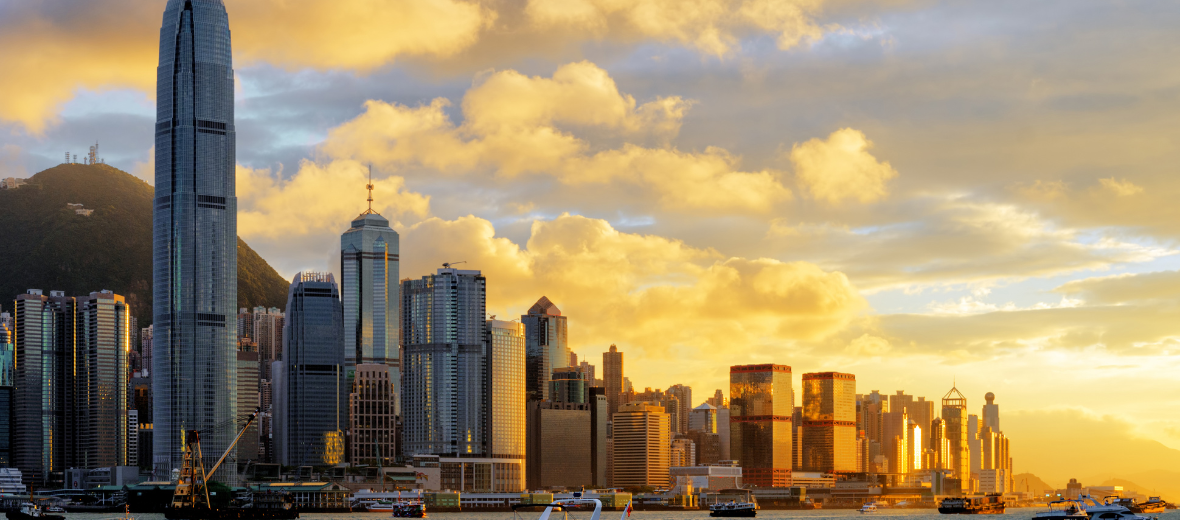
Almost 30 years ago, Hong Kong’s handover from British to Chinese rule produced exactly this kind of moment, and commentators, politicians, and journalists offered detailed forecasts of what the next 20 years would bring. Looking back at how those predictions actually played out is a useful reminder of just how unpredictable the future tends to be, and why that matters for anyone making long-term financial decisions today.
This isn’t a comment on Hong Kong’s politics, then or now. It’s simply a case study in forecasting.
What Was Predicted
At the time, several confident forecasts circulated, spanning economics, politics and culture.
On the economic side, Hong Kong was widely seen as China’s “golden goose”, its main gateway to the outside world, and many assumed it would remain that way for years to come. On the political side, some hoped Hong Kong’s more open character would gradually influence the mainland, encouraging greater openness across China. And culturally, many assumed that local identity would simply fold into the mainland’s over time.
Each of these predictions was reasonable at the time, made by informed, serious people, and each, to varying degrees, turned out to be more complicated than expected.
What Actually Happened
Hong Kong’s economic position did shift, but not in a straight line. Cities like Shanghai and Shenzhen grew into major hubs of their own, much as some had feared, while Hong Kong simultaneously took on new roles that few had predicted.
One of the clearest examples is Hong Kong’s emergence as the main channel through which international capital reaches Chinese markets, and vice versa.
Programmes like Stock Connect, launched in 2014, and Bond Connect, launched in 2017, quietly turned Hong Kong into what its own exchange now calls a “superconnector” between China and global investors, channelling a significant share of the world’s cross-border investment into Chinese markets. Nobody in 1997 predicted that Hong Kong’s most durable role would be financial plumbing between two systems, rather than a straightforward political or cultural bridge.
The picture of political and cultural change proved even more complex, with sharply differing views on how it unfolded. Some point to greater integration with the mainland, while others point to a stronger, more distinct local identity than anyone anticipated in 1997.
The point isn’t who was right, but that almost none of these forecasts played out cleanly, in either direction.
Why Predictions About Complex Systems Rarely Land
This isn’t really about Hong Kong specifically. Complex systems, whether economies, markets or geopolitics, are shaped by more moving parts than any single forecast can capture. Predictions tend to extend the present in a straight line, assuming today’s trends will simply continue. Reality is rarely so tidy.
We’ve written before about a similar problem in retirement and investment planning, where the temptation is to plan for a single expected outcome – an average return, an average retirement date, or an average market performance – rather than a genuine range of possibilities.
The 1997 predictions are simply a larger-scale version of the same habit, a single, confident forecast, built from the best information available at the time, that reality quietly declined to follow.
The Lesson For Investors
None of this means forecasting is worthless, but it does mean treating any single prediction, whether about markets, economies or a country’s future, with a healthy amount of humility.
Good financial planning doesn’t try to guess exactly what will happen. Instead, it tries to build something that holds up reasonably well across a range of futures, including the ones nobody saw coming, which is a very different exercise from picking the most likely outcome and betting the plan on it.
There’s a kind of peace of mind in that approach too – not the false comfort of thinking you’ve predicted the future correctly, but the genuine confidence of knowing your plan doesn’t depend on having done so.
The Real Takeaway
Nearly 30 years on, most of the confident predictions about Hong Kong’s future turned out to be partially right, partially wrong, and, in some cases, not close at all. That isn’t a criticism of the people who made them; it’s simply what happens when complex systems meet confident forecasts.
The lesson for anyone planning their financial future isn’t to stop thinking ahead, but to build a plan resilient enough to survive being wrong about the details, because more often than not, the future has other plans.
📩 Email us anytime: info@charltonhousewm.co.uk
📞 UK: +44 (0) 208 0044900
📞 Hong Kong: +852 39039004



 Production